Alignment Before Development

ISSUE 02 | August 2026
Development is not a substitute for alignment
Before you invest another dollar or another hour developing someone on your team, ask:
Are we developing the right person for the right role?
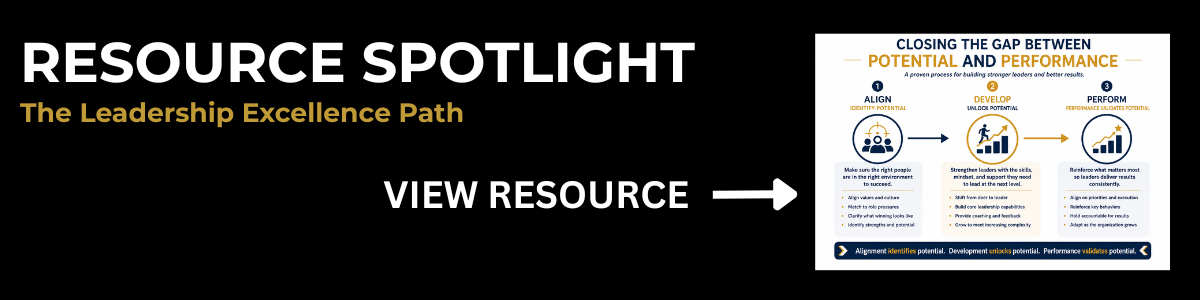
In the last issue, I introduced a simple framework for closing the gap between potential and performance:
Alignment → Potential → Development → Performance
The order matters!
Invest a few minutes to determine whether you're facing a development problem or an alignment problem.
ALIGNMENT COMES FIRST
For more than a decade, I've used Human Analytics (and I still do) to help organizations quantify the demands and pressures of a particular role and identify individuals whose natural strengths align with those demands and pressures.
I've seen the value of getting that right.
I’ve also seen the pain of getting it wrong.
When someone's natural tendencies align well with what the role consistently requires, the probability of success increases.
That alignment doesn't guarantee performance.
It creates potential.
Development then helps turn that potential into greater capability and, ultimately, sustained performance.
People can adapt.
Skills can be learned.
Performance can improve.
But that’s not really the question.
The question is:
What gives this individual and the organization the highest probability of sustained success?
That's why alignment comes first.
DEVELOPMENT OR ALIGNMENT
Someone can be naturally aligned with a role and still underperform.
They may lack experience or self-awareness. They may need to improve communication, prioritization, delegation, decision-making, or their ability to lead others.
That's where development can make a difference.
But organizations sometimes see a performance problem and immediately prescribe development:
More coaching. More training. Another book. Another seminar. Another improvement plan.
Sometimes that's exactly what's needed.
Other times, we're trying to develop our way out of an alignment problem.
Development is not a substitute for alignment.
When someone's natural tendencies fundamentally conflict with what a role consistently demands, development may improve performance. But the probability of sustained success decreases, and the investment required to achieve it increases.
And the cost isn't limited to development dollars.
It's also management time, lost productivity, delayed results, and potentially keeping the wrong person in a critical role too long.
TAKE IT TO YOUR TEAM
Think about one or two people in whom your organization is investing significant development time or resources.
Ask:
Are we developing this person because they have a high probability of succeeding in this role? Or, are we hoping development can overcome a fundamental lack of alignment?
Those are very different investments.
INVEST WHERE YOU HAVE LEVERAGE
Growing organizations have limited leadership capacity.
Your time is limited.
Your leaders' time is limited.
Your development resources are limited.
You can't afford to invest everywhere and simply hope something works.
Identify people whose natural strengths align well enough with the demands of the role to give them a high probability of success.
Then develop the heck out of those people.
Help them better understand themselves.
Help them understand others.
Help them think better, communicate more effectively, make better decisions, and lead more effectively.
That's how we begin converting potential into performance.
Twenty years ago, much of that development could happen through time, proximity, observation, and experience.
Today, it has to happen by design.
But intentional development doesn't have to mean another massive, expensive, time-consuming initiative.
For growing organizations, it can't.
It has to be practical.
It has to be intentional.
And it has to create leverage.
THE BOTTOM LINE
Alignment creates potential.
Development unlocks potential.
Performance validates potential.
Alignment doesn't guarantee performance.
But it sure improves the probability.
Then development gives aligned, high-potential people the opportunity to turn that potential into sustained performance.
Alignment → Potential → Development → Performance
The order matters.